Rubor et tumor cum calore et dolore
Redness and swelling with heat and pain. The four signs of inflammation, written down in passing and taught ever since.
De Medicina 3.10
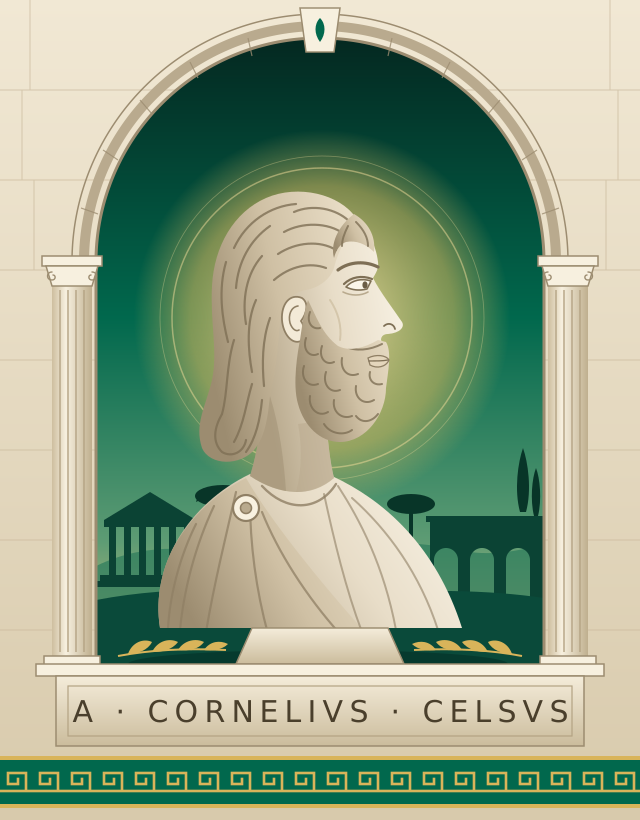
Our namesake
Roman medical writer, active under Tiberius, AD 14 to 37
Celsus wrote De Medicina: eight books on diet, drugs and surgery. It is the oldest complete medical work in Latin. Nothing else he wrote survives whole, and almost nothing is known about him.
Historians have argued for five centuries over whether he ever treated a patient. We think he did. He waits until midnight to feed a fever patient, once the worst has passed. He admits when he has never seen an operation succeed. When the only treatment left may kill, he tells the doctor to explain the danger to the family first.
He distrusted fashion, disliked doctors who took on a crowd of patients for the money, and was plain about what medicine could not cure. We named ourselves after him.
A doubtful hope is preferable to certain despair.
From De Medicina
Redness and swelling with heat and pain. The four signs of inflammation, written down in passing and taught ever since.
De Medicina 3.10
A bleeding vessel is tied in two places and cut between. The method is usually credited to Paré, fifteen centuries later.
De Medicina 5.26
His verdict on cutting open the living to learn anatomy: as cruel as it is needless. Dissect the dead, he said, and learn the rest at the bedside.
Prooemium 74
A strong and steady hand which never trembles, the left as ready as the right, sharp sight, and enough pity to want the patient cured without being hurried by his cries.
De Medicina 7, preface
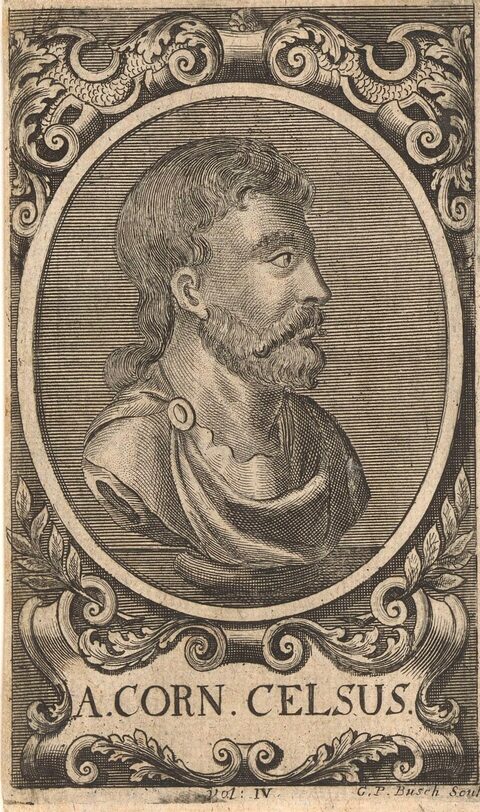
About the portrait
No likeness of Celsus survives from his own time. Every portrait of him is imagined, including ours. We drew it after this engraving by Georg Paul Busch, made in 1719 and now in the Rijksmuseum, Amsterdam, and set the bust in a Roman arch.
Engraving: Rijksmuseum, RP-P-1908-2809. Public domain.