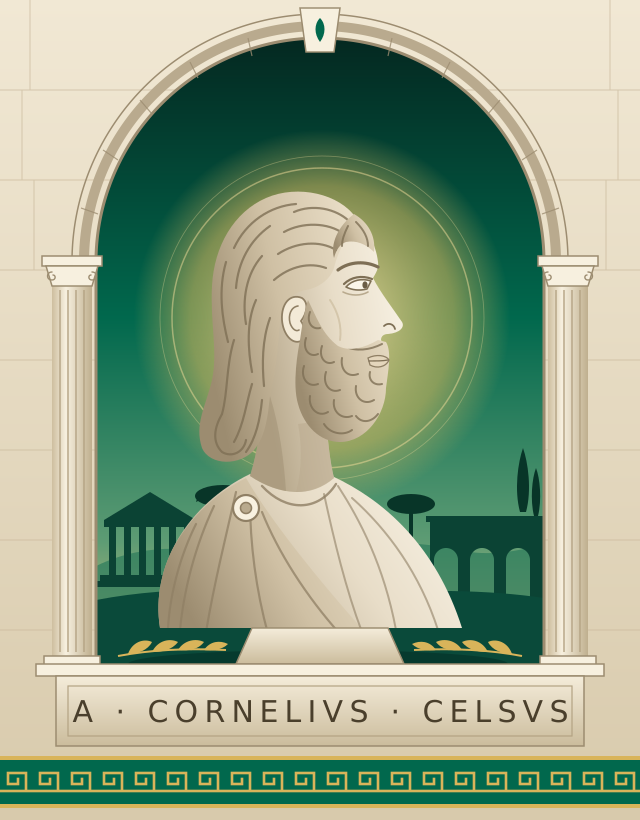
Aulus Cornelius Celsus was a Roman writer of the reign of Tiberius (AD 14 to 37). His eight books De Medicina are the oldest surviving comprehensive account of medicine in Latin. They are all that remains of a larger encyclopaedia, the Artes, which also covered agriculture, military science, rhetoric and probably philosophy.
Almost nothing is known of the man. No ancient source gives his birthplace, his dates or his profession. What is secure is the book: a clear, ordered and unusually humane survey of Hellenistic and early Roman medicine, in a Latin that Renaissance readers ranked with Cicero's.
At a glance
| Question | What the evidence supports | Standing |
|---|---|---|
| Name | Cornelius Celsus in every ancient citation. The praenomen is abbreviated "A.": Aulus, since Aurelius is not a praenomen. | Secure; Aulus probable |
| When | Active under Tiberius. Columella calls him a man "of our own time". | Secure to a generation |
| Born c. 25 BC, died c. AD 50 | No ancient source gives either date. | Conjecture |
| Where | Unknown. The theory that he came from Gallia Narbonensis rests on his mention of one grape variety. | Conjecture |
| Rank | Often called a nobleman. Nothing ancient attests it. | Unsupported |
| What he wrote | An encyclopaedia: agriculture in five books, medicine in eight, rhetoric and military science. Philosophy is attested separately. | Secure for the first four |
| A physician? | Pliny lists him among Roman authors, not among doctors. The text is full of first-person clinical remarks. | Probable, from the text |
| What survives | De Medicina, complete. | Secure |
Life and dates
Everything known about Celsus comes from his own book and from three writers of the next two generations.
- Columella, writing on agriculture around AD 60, names "men of our own time, Cornelius Celsus and Julius Atticus" and says that Celsus "has embraced the whole substance of the subject in five books" (De Re Rustica 1.1.14).2 He cites him about thirty times.6 This is the firmest evidence for the date.
- Quintilian, near the end of the century, calls him mediocri vir ingenio, who nonetheless wrote on all the rhetorical arts "and left precepts on military science, agriculture and medicine as well" (Institutio Oratoria 12.11.24).3 He cites Celsus twenty-five times and says his philosophy was written non sine cultu ac nitore, not without refinement and elegance.6
- Pliny the Elder names Celsus as a source for at least eighteen books of the Natural History, always under the heading Ex auctoribus, the list of Roman authors.4
The book itself supports a Tiberian date. Celsus says that Themison, the successor of Asclepiades, changed his views "recently" (nuper) in old age, and he speaks of Cassius as ingeniosissimus saeculi nostri medicus, quem nuper vidimus: the most gifted doctor of our time, whom we lately saw (Prooemium 11, 69).1
Quintilian's mediocri is usually translated "of moderate talent" and read as a rival specialist's jab at an encyclopaedist. David Daube argued that it is not a slight at all and means something nearer "a man of comprehensive mind".7 Either way, Quintilian's point in the passage is that Celsus mastered many fields.
The praenomen
Manuscripts and early editions print "Aurelius Cornelius Celsus". That cannot be right: Aurelius is a family name. Aulus is the accepted expansion of the "A."1
The dates 25 BC to AD 50
These appear in most reference works as if they were recorded. They are estimates. The Loeb introduction says only that "some would put his birth in 25 B.C.", and no death date has any ancient support.1
The Artes
De Medicina was one part of a general encyclopaedia in the tradition of Varro, usually called the Artes. The title is a modern convenience. Medicine followed agriculture, as the first sentence of the work says: Ut alimenta sanis corporibus agricultura, sic sanitatem aegris Medicina promittit. As agriculture promises food to the healthy, so medicine promises health to the sick.1
| Part | Evidence | Survives |
|---|---|---|
| Agriculture, 5 books | Columella 1.1.14 and frequent citations | Fragments in Columella |
| Medicine, 8 books | The text itself | Complete |
| Rhetoric | Quintilian | Fragments in Quintilian |
| Military science | Quintilian 12.11.24 | Lost |
| Philosophy | Quintilian 10.1.124 | Lost |
| Jurisprudence | Inferred by modern editors | Lost, and doubtful |
De Medicina
The work is organised by treatment. Celsus takes the Hellenistic division of medicine into three parts, one that cures by diet, one by drugs and one by the hand (Prooemium 9), and builds the eight books on it.1
| Books | Subject | Contents |
|---|---|---|
| Prooemium | History and method | Medicine from Hippocrates to Asclepiades, and the dispute between the sects |
| 1 to 4 | Diseases treated by regimen | Keeping well; signs and prognosis; fevers and general diseases; diseases by part of the body |
| 5 to 6 | Diseases treated by drugs | Drugs and compound remedies; wounds, bites and ulcers; the skin, eyes, ears, mouth and genitals |
| 7 | Surgery | Abscess, fistula, missiles, the eye, hernia, stone, varicose veins, amputation |
| 8 | Bones | The skeleton, fractures, dislocations |
The preface and the sects
The preface is the best surviving account of the argument that divided Hellenistic medicine.
- The Dogmatists held that treatment requires "a knowledge of hidden causes", and so of anatomy and physiology. They defended Herophilus and Erasistratus, who "laid open men whilst alive" (Prooemium 13, 23).
- The Empiricists answered that "nature is not to be comprehended", as the quarrels of the theorists proved, and that medicine rests on what experience has shown to work (27 to 28).
- The Methodists, followers of Themison, wanted to be classed with neither and reduced disease to a few common states (54 to 57).
Celsus gives each side its full case and then his own verdict: rationalem quidem puto medicinam esse debere, instrui vero ab evidentibus causis. Medicine should be reasoned, but it should take its instruction from evident causes. On anatomy: "to lay open the bodies of men whilst still alive is as cruel as it is needless; that of the dead is a necessity for the learner" (74).1
Temper
The book's manner is its most distinctive feature. Celsus reports what the authorities say, where they disagree, and what he would do. Asclepiades held that the doctor should treat "safely, speedily, and pleasantly". Celsus adds that "there is generally danger both in too much haste and too much pleasure" (3.4). When a treatment fails he puts the patient ahead of the textbook: one should not think so much about the authority as about the patient, and try something else (3.1).1, 7
A practitioner of experience does not forthwith seize with his hand the patient's forearm but at first sits down and with a cheerful countenance inquires of the patient how he does.
Was Celsus a physician?
We think he was. De Medicina reads as the work of someone who had stood at the bedside. No ancient source says so, and scholars have disagreed since the Renaissance, so the case rests on the text.
| For a layman | For a practitioner |
|---|---|
| Pliny lists him among the auctores, not the medici. | He writes in the first person about treatment, in more than a hundred places by Spencer's count. |
| Quintilian treats him as a polymath who also wrote on war, farming and oratory. | He admits failure: of one eyelid operation, "I for my part do not remember anyone to have been so cured" (7.7.6). |
| Medical knowledge was part of a Roman gentleman's education and was needed to run a large household. | The surgical books give technique, variations, complications and aftercare in a practitioner's detail. |
| He never calls himself medicus. | He overrules Asclepiades on emetics from his own experience: experimentis credo (1.3.21). |
The translation theories
Friedrich Marx, editor of the standard text (1915), believed the medical books were adapted from a Greek treatise by Titus Aufidius Siculus. Max Wellmann thought the source was Cassius. The Loeb introduction calls this "a possible, but an unproved hypothesis".1 Bruno Meinecke answered both in 1941: Celsus cites some eighty authorities and names Cassius three times, so he was not hiding a source, and he refers to his own books on agriculture, which no Greek physician wrote.6 Pliny, who says outright that Julius Graecinus copied Celsus on vines, knew a copyist when he saw one and did not treat Celsus as one.
Gentleman amateur, or doctor
Meinecke's own answer was that Celsus "was not a medicus in the professional sense, but a scholarly scientist", whose skill was "undoubtedly acquired by attendance upon slaves and the familia rustica in the valetudinaria", the sick-rooms of a large estate.6
W. G. Spencer, the surgeon who later translated the work for the Loeb Library, had already called that theory "just the reverse of the truth". The patients in De Medicina have wealth and leisure: they are sent on sea voyages and to mineral springs. The only mention of valetudinaria is a criticism of those who run large ones and cannot attend to individuals.5
Betty Spivack made the fullest case in 1991. Celsus himself calls Hippocrates auctor and never medicus, so the word means "an authority". He says one becomes a farmer or a pilot by practice and not by argument, and that bleeding is easy for the experienced and dangerous in ignorant hands. He attacks doctors who take on a crowd of patients for profit: "one physician cannot treat many patients" (3.4).7
She rests most on one passage. When bleeding is the only hope but may kill, "it is the mark of the good physician to demonstrate that there is no hope without bleeding, and to confess how much risk there is in doing this, and then, if it is demanded, to bleed the patient" (2.10). That is a clinician describing consent.7
Christian Schulze's monograph of 1999, the only book-length study of the question, argues from the prefaces, the surgery and the intended readership that author and audience were both medical.12
Celsus beside Pliny
The layman theory treats Celsus as the same kind of writer as Pliny the Elder: a learned Roman landowner compiling medicine from books. Reading them side by side is the best argument against it. Pliny arranges medicine by substance, listing what each plant, animal and mineral is good for, and he is openly hostile to doctors, who "acquire their knowledge from our dangers, making experiments at the cost of our lives" (Natural History 29.18).7 Celsus arranges it by disease and by operation, with signs, timing and aftercare, and weighs Hippocrates, Asclepiades and Meges against each other and against what he has seen.
Pliny writes about medicine at great length and from outside. Celsus writes less and sounds like someone who has done it. We suspect that much of the modern doubt about Celsus comes from filing the two together.
Our verdict
The external evidence proves little either way. Pliny's heading auctores covers every Roman he cites, and his medici are Greeks: the classification separates Roman authors from Greek professionals, not doctors from laymen.4 Quintilian is discussing breadth of learning. The internal evidence points one way: the first-person remarks, the admissions of failure, the bedside detail, the surgery. That he also wrote on farming, war and oratory makes him unusual, and no less a doctor. What cannot be shown is how he practised: for a living, among his own class, or in his own household.
Sources and Latin
Celsus drew on the Hippocratic writings and on Hellenistic and Roman authors whose works are lost: Asclepiades, Heracleides of Tarentum, Erasistratus and Meges of Sidon among them. For several he is now the main witness. The preface to the surgery names the Alexandrians Philoxenus, Gorgias, Sostratus, Heron, the two Apollonii and Ammonius, and at Rome Tryphon, Euelpistus and Meges, the most learned of them all.1
He was writing Greek medicine in a language with little technical vocabulary for it. His usual method is to give the Latin word and then the Greek one, and to borrow the Greek term where Latin had none. He is frank about the limits. Of the genitals he says that the Greek words are the more tolerable and are now accepted, while the Latin ones are too coarse for anyone who would speak with modesty (6.18).1
He wrote before Galen, so the Galenic vocabulary that shaped later medical Latin is absent, and a modern reader can mistake his terms for their later meanings.10 The clearest case is cancer, below. The standard study of his language is D. R. Langslow's Medical Latin in the Roman Empire.13
What the text says
Celsus is credited with a long list of firsts. Most are first surviving descriptions. He is reporting practice developed by others, and says so.
The four signs of inflammation
Notae vero inflammationis sunt quattuor: rubor et tumor cum calore et dolore. "Now the signs of an inflammation are four: redness and swelling with heat and pain" (3.10).1
The sentence is a passing remark. Celsus is discussing what to apply to a painful chest in a patient with fever, and gives the signs so the reader can tell whether inflammation is present before choosing a plaster. He then corrects Erasistratus, who "greatly erred, when he said that no fever occurred apart from inflammation". He does not present the four signs as a discovery.
The fifth sign, functio laesa, is not in Celsus, and it is not in Galen either. L. J. Rather searched Galen for it and concluded that Galen "could not have consciously added functio laesa", because neither the four signs, the name of Celsus nor the phrase "cardinal sign" occurs in his surviving works.8
| Year | Source | What it says |
|---|---|---|
| 1864 | Uhle and Wagner | Add "disturbance of function" to the four signs as a fifth symptom. No Latin, and no mention of Galen. |
| 1877 | Perls | First use of the Latin tag functio laesa. |
| 1919 | Tendeloo | The earliest statement Rather could find that Galen added a fifth sign. |
Virchow is often named as its author. In 1854 he listed the four signs of Celsus and "said nothing of functio laesa or disturbed function as a fifth cardinal sign".8
Cancer
It is often said that Celsus translated the Greek karkinos as cancer. For the malignant growth he keeps the Greek word: Non idem periculum carcinoma adfert (5.28.2). His Latin cancer is a different thing, the spreading gangrene of a wound or ulcer: Omnis autem cancer non solum id corrumpit, quod occupavit, sed etiam serpit. Every cancer destroys what it has seized and also creeps (5.26.31).1
His account of carcinoma is sharp. It "occurs mostly in the upper parts of the body, in the region of the face, nose, ears, lips". It passes through stages, and only the first can be removed: "the other stages are irritated by treatment". Of surgery he says: "After excision, even when a scar has formed, none the less the disease has returned, and caused death."
Surgery
| Operation | What Celsus describes | Where |
|---|---|---|
| Haemorrhage | Vessels that keep bleeding "are to be tied in two places and cut across between". | 5.26.21 |
| Abscess | A linear incision, as few and as small as will drain the deepest part of the cavity. | 7.2 |
| Anal fistula | A linen thread passed along the track and tied loosely, while the patient "can do his business, walk, bathe, and take food as if in the best of health": the seton. | 7.4 |
| Missiles | Enlarge the wound before extraction, so the barb does not tear on the way out. | 7.5 |
| Cataract | Couching with a needle, "one of the most delicate operations". Wait until the cataract has hardened. | 7.7 |
| Tonsils | Freed with a finger, or excised with a hook and scalpel. | 7.12 |
| Abdominal wounds | Check the colour of prolapsed bowel, enlarge the wound to return it, close in two layers. | 7.16 |
| Bladder stone | Perineal lithotomy through "a semilunar cut", in spring only, in a boy "not less than nine years of age and not more than fourteen". | 7.26 |
| Varicose veins | Cautery, or excision with hooks. | 7.31 |
| Gangrene | Amputation through sound flesh, with the warning that "patients often die under the operation, either from loss of blood or syncope". | 7.33 |
Ligature of vessels is usually dated to Ambroise Paré in the sixteenth century. Paré cited Celsus for it.7
A surgeon should be youthful, or at any rate nearer youth than age, with a strong and steady hand, which never starts to tremble, prompt no less with the left than with the right hand, with vision sharp and clear, a spirit undaunted, pitiful but so as to wish to cure the patient whom he undertakes, yet not moved by his clamour.
Skin
Books 5 and 6 hold the fullest ancient Latin account of skin disease, and dermatology keeps his name.
- Kerion Celsi. An ulceration "which the Greeks call κηρίον from its resemblance to honeycomb", one form of it on the scalp (5.28.13).
- Area Celsi. Patchy baldness in two forms: one that "spreads without defined configuration" in the scalp or beard, and one that creeps forward from the back of the head and is seen mostly in young children (6.4).
- Warts. Acrochordon, thymion, myrmecia and clavus (5.28.14). These are Greek names he records, not names he coined.
Transmission and reception
Celsus had little medical afterlife in antiquity. Later physicians wrote in Greek and built on Galen, and the Latin Middle Ages barely knew him. The text survived in a handful of early copies.1
| Siglum | Manuscript | Date | Note |
|---|---|---|---|
| F | Florence, Biblioteca Medicea Laurenziana, 73.1 | 9th century | Partly defective |
| V | Vatican, lat. 5951 | 9th century | Partly defective |
| P | Paris, Bibliothèque nationale, lat. 7928 | 10th century | Copied from V when V was more complete |
| J | Florence, Laurenziana, 73.7 | 15th century | Copied by Niccolò Niccoli from an old codex now lost |
The humanists recovered the text in the fifteenth century. In January 1426 Guarino of Verona was asking Giovanni Lamola for news of a reported Celsus, and around the middle of 1427 Lamola found a codex in the basilica of Sant'Ambrogio in Milan, now manuscript F.11 A second tradition, repeated in the medical literature, has Tommaso Parentucelli, the future Pope Nicholas V, finding a copy in Milan in 1443.7 We have not been able to reconcile the two.
De Medicina was printed at Florence in 1478, edited by Bartolomeo Fonzio from a copy made by his brother and corrected against the ninth-century Florentine manuscript.10 It was among the first medical books in print, and its Latin made it a humanist favourite: Celsus became the Cicero medicorum, the Cicero of the physicians.7 The Loeb introduction counts 49 printed editions down to 1841. Marx's edition of 1915 is the standard text, and Spencer's Loeb prints it with a facing translation.1
Errors in circulation
| Claim | Correction |
|---|---|
| "Aurelius" Cornelius Celsus | Aurelius is not a praenomen. Aulus. |
| He lived from 25 BC to AD 50 | A guess. Activity under Tiberius is all that is attested. |
| He was a Roman nobleman | No ancient evidence. The idea goes back to Garrison's History of Medicine, which made him "a private gentleman of the noble family of the Cornelii".7 |
| He was a compiler, not a doctor | Unproven, and against the grain of the text. See above. |
| He translated karkinos as cancer | He uses carcinoma for malignancy. His cancer is gangrene. |
| He discovered the four signs of inflammation | He records them in passing, as known. |
| Galen added functio laesa | Not in Galen. First attributed to him in 1919; the tag itself dates from 1877. |
| He invented the operations he describes | These are first surviving descriptions. He names his surgical predecessors himself, and the best recent survey concludes that no invention of his own can be proved.9 |
References
- 1Celsus. De Medicina. Text of F. Marx (Corpus Medicorum Latinorum I, Leipzig: Teubner, 1915), with an English translation by W. G. Spencer and an introduction by W. H. S. Jones. Loeb Classical Library, 3 vols. Cambridge, Mass.: Harvard University Press, 1935 to 1938. Link
- 2Columella. De Re Rustica, Book 1. Link
- 3Quintilian. Institutio Oratoria 10.1.124; 12.11.24.
- 4Pliny the Elder. Naturalis Historia, Book 1 (lists of sources, Books 7 to 30). Link
- 5Spencer WG. Celsus' De Medicina: a learned and experienced practitioner upon what the art of medicine could then accomplish. Proceedings of the Royal Society of Medicine 1926;19(Section of the History of Medicine):129-139. Link
- 6Meinecke B. Aulus Cornelius Celsus: plagiarist or artifex medicinae? Bulletin of the History of Medicine 1941;10:288-298.
- 7Spivack BS. A. C. Celsus: Roman medicus. Journal of the History of Medicine and Allied Sciences 1991;46:143-157. Link
- 8Rather LJ. Disturbance of function (functio laesa): the legendary fifth cardinal sign of inflammation, added by Galen to the four cardinal signs of Celsus. Bulletin of the New York Academy of Medicine 1971;47:303-322. Link
- 9Köckerling F, Köckerling D, Lomas C. Cornelius Celsus: ancient encyclopedist, surgeon-scientist, or master of surgery? Langenbeck's Archives of Surgery 2013;398:609-616. Link
- 10Donaldson IML. Reflections on translating passages on "empirical" and "dogmatic" medicine in Celsus's De medicina. Part 1. Journal of the Royal Society of Medicine 2021;114:359-362. Link
- 11Arbizzoni G. Lamola, Giovanni. Dizionario Biografico degli Italiani, vol. 63. Rome: Istituto della Enciclopedia Italiana, 2004. Link
- 12Schulze C. Aulus Cornelius Celsus: Arzt oder Laie? Trier: Wissenschaftlicher Verlag Trier, 1999.
- 13Langslow DR. Medical Latin in the Roman Empire. Oxford: Oxford University Press, 2000.
Quotations from De Medicina are from W. G. Spencer's translation unless the reference shows another source. Corrections are welcome: write to us.